Questions / Answers
Frequently Asked Questions
Can you stir your paella while cooking?
When preparing, it is obviously essential to stir the different ingredients so that they are well browned and cooked.
On the other hand, when the rice begins to cook, place the ingredients in the pan and do not stir.
What ingredients should be avoided?
There are many, and there are many misinterpretations. Peas and chorizo are often found in paellas. Well, no, peas and chorizo are NEVER put in a paella. This is the work of cooks who don’t know the original recipes and who add all kinds of ingredients, sometimes folkloric. So we forget about chorizo, cold cuts, peas, classic long rice, merguez sausages, squid fritters, and many others.
On the other hand, it is possible to find green beans and white beans (be careful not to use just any beans), pimentón / paprika (to slightly spice up the paella), artichokes, sausage or even peppers.
Obviously, a recipe is never set in stone. Everything can change! We’ve had paellas with strange ingredients a few times in Spain. But the majority of Spanish paella lovers will tell you that adding certain ingredients is heresy! Occasionally, ask a Spanish person if they add chorizo to their paella. And if you want even more discord, ask them if they need onions in the tortilla. 😉
Should I rinse rice before cooking?
No, you never rinse the rice before cooking it when preparing paella. This is a misconception from other rice dishes. By washing the rice grains, you will remove the starch, which is essential for preparing the socarrat (the toasted crust that accumulates at the bottom of the pan at the end of cooking).
Rinsing rice also means it will begin to absorb moisture. This can change the proportions of water needed for cooking and alter its structure.
Should I cover when cooking?
No, you don’t cover the paella while cooking. However, you can cover it after cooking to finish cooking the rice.
What ingredients are essential for a successful paella?
That’s a very good question! First, you need to know which paella you’re referring to? There are several recipes involving different ingredients!
The ingredients added to most paellas are: Valencian Designation of Origin rice, saffron, chicken, tomatoes, olive oil, and the water needed for the broth. Depending on the recipe, other ingredients are added, such as seafood, rabbit, pork, peppers, etc.
For example, the traditional Valencian recipe calls for Valencian PDO rice, chicken, rabbit, green coco beans, white beans (called garrofòs), saffron, olive oil, tomatoes, and a few liters of water.
Can you make paella without saffron?
Saffron is a staple in every paella recipe! It’s an essential ingredient in the preparation of paella. It’s this spice, also called red gold, that gives paella its distinctive flavor and yellowish color.
The downside, is that saffron is extremely expensive. It is (too) often replaced with bags of paella spices. Unfortunately, these bags do not usually contain a single strand of saffron. There are many dyes whose effects can be harmful to health. So look for some information about the monoazoic synthetic dye Tartrazine E-102. It is found in all paella spice bags, because it is a yellow dye.
We do not recommend the use of this type of product. You will most likely prepare one or two paella in a year. Prefer a few grams of good saffron to these pigs!
Should I cook my paella over a wood fire?
Traditionally, a paella is cooked over a wood fire. However, mastery of fire is essential to success. This can greatly complicate cooking. Today, using a gas burner to cook a paella is very common. It is also possible to make it on induction hobs with a small suitable pan. No one will shout at the scandal if you use one or the other of these possibilities, what counts, is the final taste that will have your paella!
How to serve a paella?
The answer is simple: in its pan. No, you do not transvase the paella once cooked in a dish. It is proudly presented in its pan, and each plate is filled by serving directly from the pan.
When preparing, do you have to reserve each ingredient or can you leave them on the pan?
There are two schools:
- cook each ingredient and set them aside to prevent them from continuing to cook.
- cook each ingredient and position them towards the outside of the pan (at the widest diameter) if it is not hot.
Either way works! The first method is ideal for beginners. Reserve ingredients after cooking to prevent continued cooking and burning.
The second method is that used by specialists. When they start cooking the ingredients, only the center of the pan is heated to cook the ingredients. The outside of the pan is not heated which allows the ingredients to push and limit the continuation of cooking. You can try this method if you have a multi-burner burner. In this case, you’ll start the preparation with the center fire, and possibly the second fire. The last fire is lit only when the rice is cooked.
Attention, shellfish should always be reserved after cooking. The overcooking of these foods is very fast.
Both methods are detailed here.
Did my pan stick while cooking the rice?
The term hung can be subject to misinterpretation. Are we talking about sticky rice or burnt rice?
A rice that has slightly stuck to the bottom of the pan is the sign of a successful paella. You have successfully created the socarrat. This is the crispy crust formed by the rice in the bottom of the pan. This is the hardest ingredient to get when cooking a paella!
On the other hand, if you refer to burnt rice, it is certain that you lacked a little suquet (broth) and / or that the power of your fire was not mastered. Creating that beloved rice crust on the bottom of the pan requires properly controlling the cooking of the rice. There should be enough broth to cook, and stop the heat just before the rice burns. Obtaining a good socarrat requires several preparations of paella to any cook!
Was my rice not cooked enough?
This is probably because you ran out of broth to finish cooking the rice. There are two schools in broth preparation:
- prepare its broth separately
- prepare your broth directly in the paella pan
The first way, simpler and more accessible, is especially for beginner cooks. It is possible to prepare its suquet (broth) separately in a saucepan. You can prepare it before starting the paella, while keeping it warm. It is better to prepare a little more broth than necessary. In fact, if you lack it, and although this is not recommended, it is better to add broth than to have undercooked rice. Add a few ladles of broth will not destroy all your work, on the contrary they risk saving your paella!
The second school is more complex. It consists of getting the broth directly into the paella pan after cooking the various ingredients. The difficulty lies in the amount of broth to have. There should be enough to cook the rice, but there should also be not too much so that the rice is not overcooked. In fact, as long as there is broth, and as much as it can, the rice will absorb it which risks creating a rice paste. It is particularly difficult to achieve! In fact, you need to introduce enough liters of water to prepare a good broth, then cook the rice. Don’t forget that the broth will reduce in the oven and as it heats up.
Which is poured into the pan first: the rice or the broth?
It is a question that is strangely similar to: which came first the chicken or the egg?
When preparing a paella, this question about the order in which to cook the ingredients comes up all the time.
The answer is simple: it depends on the type of paella you are preparing!
If you prepare a Valencian paella according to the rules of art, you prepare the broth after cooking the ingredients. It is left to simmer for a good while to reduce. Then, when the broth is ready, add the rice.
Other paella recipes will “starch” the rice in the sofrito. Then, the broth is added to finalize the cooking of the rice. This is especially the case with the seafood paella.
The most important thing remains the taste quality of your fish broth or smoke. The more flavor it has, the more concentrated the rice will be in flavor.
What wine to accompany a paella?
A mez-plate arrangement depends on the ingredients that make up the dish. This statement also applies to paellas. The choice of a wine therefore depends on the prepared recipe.
- A red wine for a paella consisting mainly of meat.
- A white wine for fish and shellfish paellas.
- A rosé wine for the mixed recipe (land and sea).
For suggestions on appellation of red, white and rosé wines, refer to our article dedicated to choosing a wine for a paella. It has a large list of Spanish and French wine names for each recipe on our site.
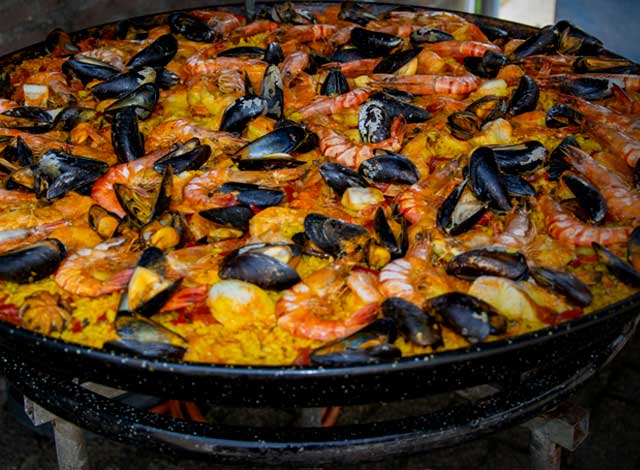
What utensils do you need to make a paella?

There are many terms from Spanish and Valencian languages. Read our lexicon to know what each word means!